
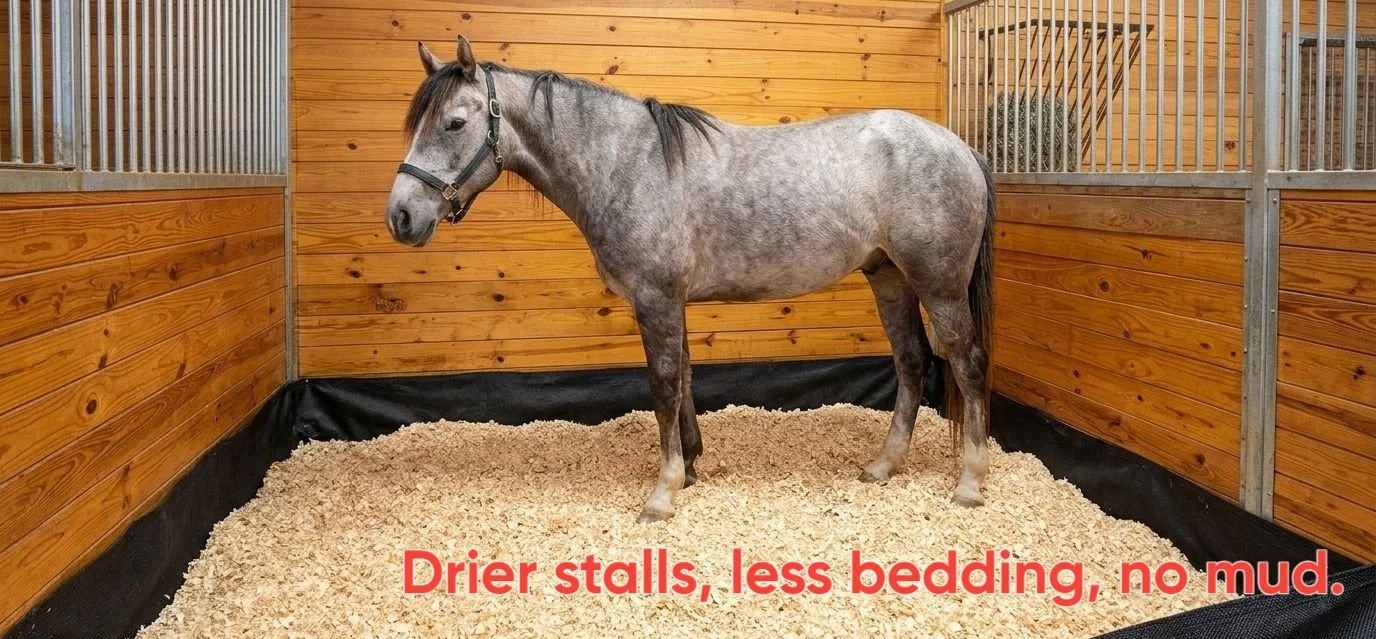
STALL MASTER GUARD Horse Stall Liners
DRAINS 45+ GALLONS PER SQ FT PER MINUTE
BEDDING LAST 2 TO 3 TIMES LONGER
TOUGH NONWOVEN POLYPROPYLENE
MADE IN THE USA
Liner vs. rubber mat Comparison table
| Feature | STALL MASTER GUARD | Rubber mat |
|---|---|---|
| Drainage |
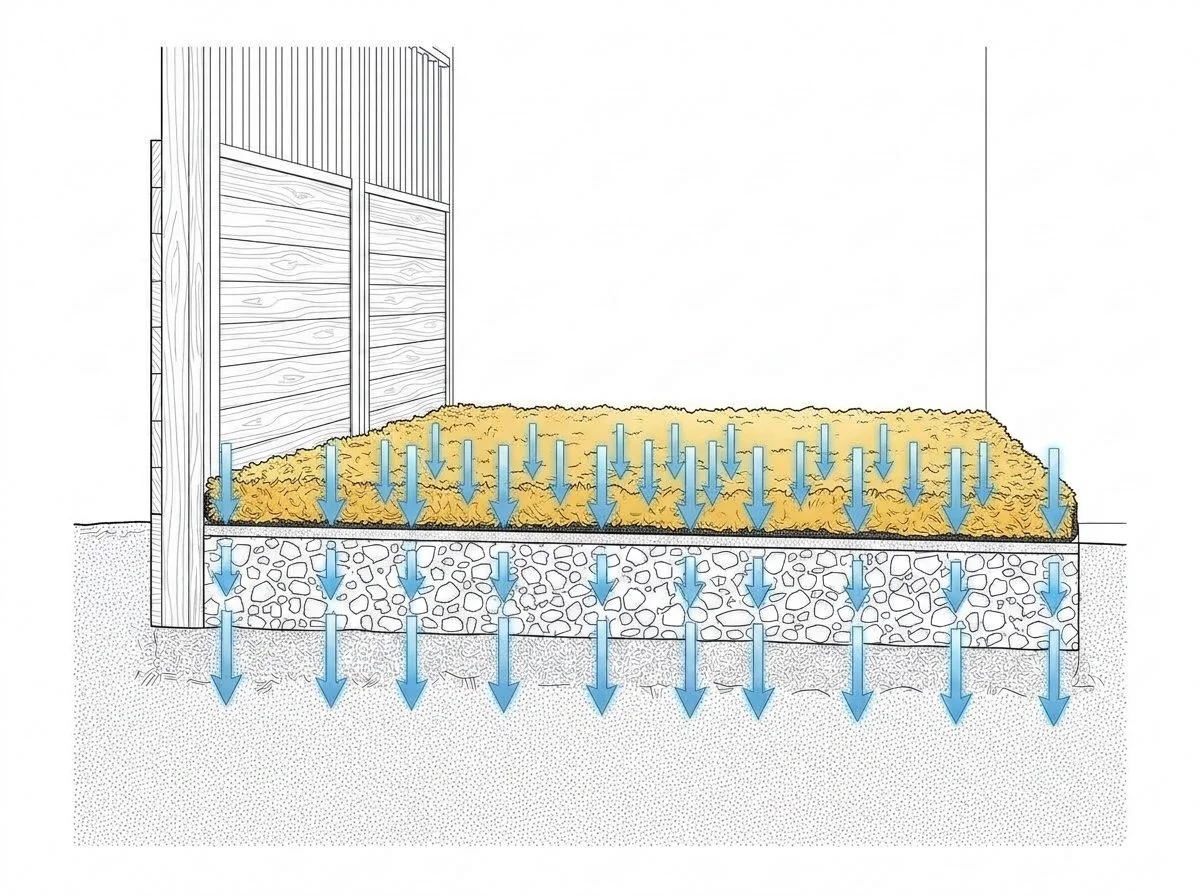
• High permeability (45+ gal/sq ft/min) • Liquids drain straight down into sub-base • Prevents standing pools and trapped moisture |
• Most rubber mats don't drain (solid surfaces) • Liquids puddle on top or pool in low spots • Urine often seeps between mat seams into sub-base |
| Bedding use |
• Separates bedding from dirt/clay base • Cuts shavings consumption by 50%–60% (2–3x life) • Clean shavings don't mix into mud or slurry |
• Bedding sits directly on rubber surface • High daily waste as wet shavings stick to mats • Requires frequent full strip-outs due to saturation |
| Weight / install |
• Lightweight roll material (~16 oz/yd²) • Easily rolled out, trimmed, and screwed to walls • One-person installation with zero heavy lifting |
• Extremely heavy (often 100+ lbs per 4x6 mat) • Requires multiple people and heavy labor to position • Prone to shifting, buckling, and gapping over time |
| Cost per sq ft |
• Low initial investment (~$1.33 / sq ft) • Pays for itself in 3 to 4 months via bedding savings • Economical option for full-barn retrofits |
• High upfront purchase and heavy freight costs • Expensive per square foot for premium thick rubber • Ongoing hidden costs due to high bedding replacement |

Dry bedding
Urine and water drain through
Mud-free paddocks
Safer footing in rain
Easy cleaning
Pour disinfectant through
Stall Liner Specs
| Material | Nonwoven polypropylene |
| Flow rate | 45+ gal / sq ft / min |
| Weight | 16 oz / yd² |
| Roll sizes | Custom cut-to-size (Standard widths up to 15' available) |
| Thickness | 4.45 mm (~0.175") |

Bedding savings example
Bedding Savings & Liner ROI Example
See how Stall Master Guard extends bedding life 2–3x and pays for itself in under 4 months.
1. Liner Price Breakdown (10' × 15')
Calculated at $1.33/sq. ft. standard rate:- Dimensions: 10' × 15'
- Total Coverage Area: 150 sq. ft.
- Square Feet (× 1.33): $199.50
- Final Liner Price: $199.50
At $60.00 saved per month on shavings, this $199.50 liner pays for itself in 3.3 months.
2. Monthly & Annual Bedding Savings
Based on daily mucking & shavings at $7.50/bag:| Metric | Without Liner | With Stall Master Guard |
|---|---|---|
| Bags / Month | 13 bags | 5 bags |
| Monthly Cost | $97.50 / mo | $37.50 / mo |
| Annual Cost | $1,170.00 / yr | $450.00 / yr |
| Full Strip-Outs | Every 3 weeks | Every 3–4 months |
- Save 8 bags of shavings/month (over 2.5x longer bedding life).
- Save $60.00/month ($720.00/year) on just one stall.
Installation guide
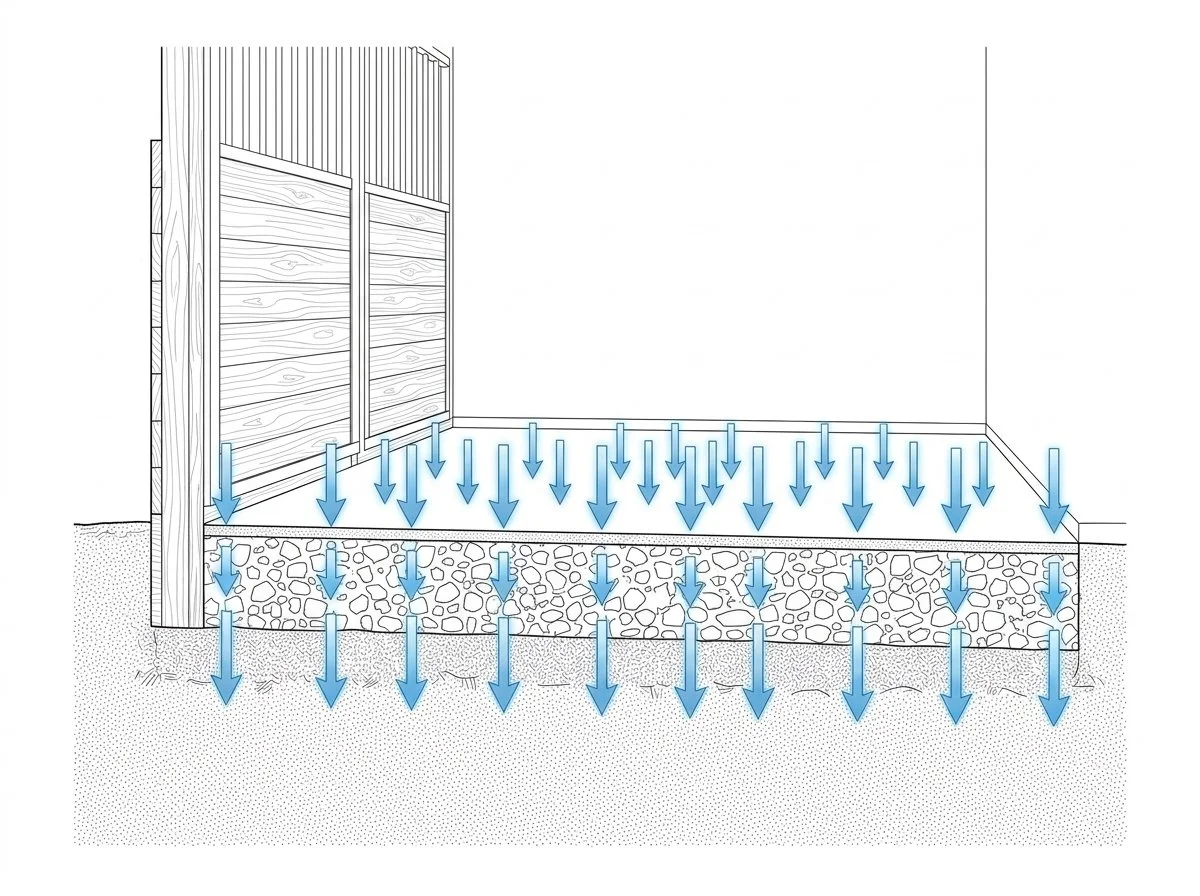
Step 1: Prepare & Test Your Sub-Base Drainage
Maximizing bedding life starts beneath the liner. Because Stall Master Guard allows liquid to pass straight through into the ground below, a fast-draining sub-base is essential:
Run a Quick Drain Test: Pour a 5-gallon bucket of water onto the bare stall floor. If it absorbs steadily into the ground, your base is ready.
Improve Slow-Draining Floors: If water pools on top, lay down 4 to 6 inches of compacted crushed limestone, screenings, or locally available drainage stone before installing.
Add a French Drain / Leach Pit (Optional): For heavy-wetting horses or clay soil, dig a 2' × 2' pit in the center or low spot of the stall, fill it with clean pea gravel or crushed stone, and grade the surrounding floor slightly toward the pit.
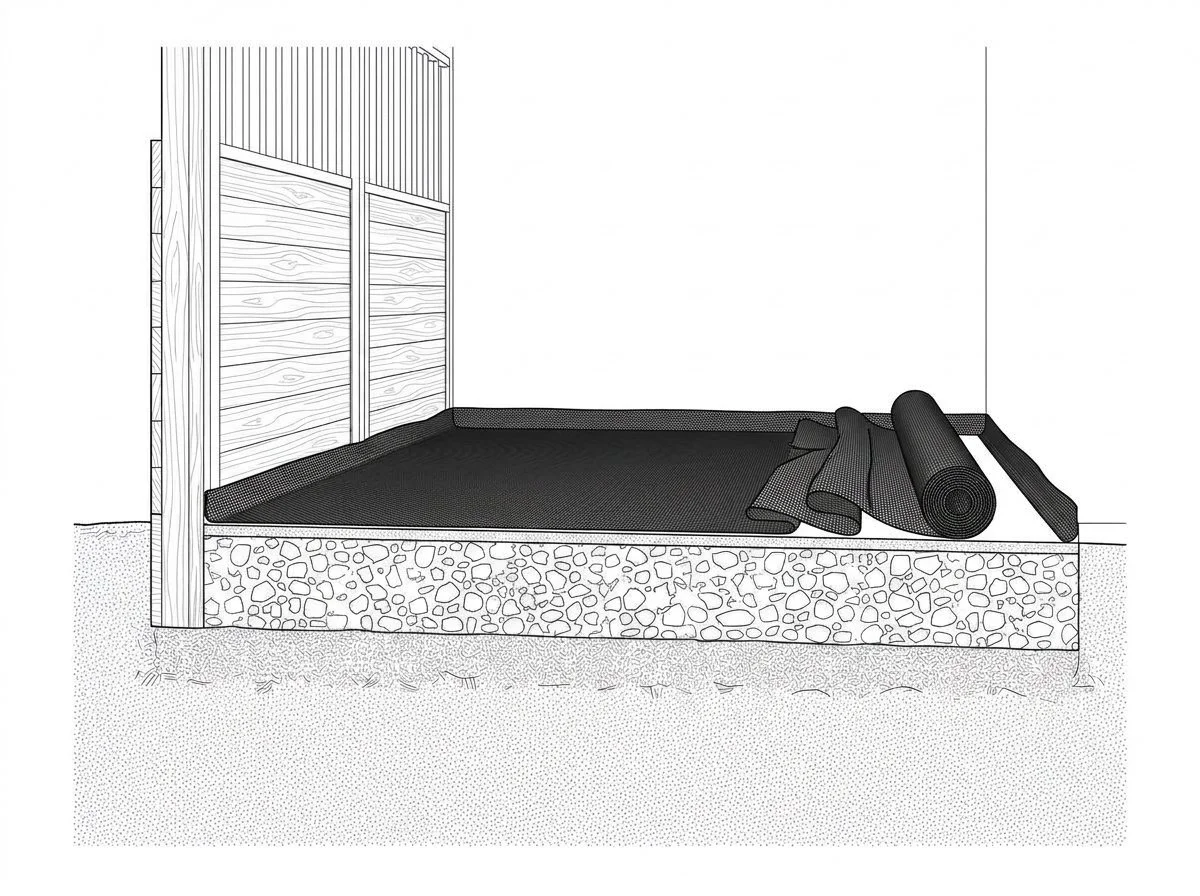
Step 2: Position & Orient the Liner
Correct Side Up: Unroll your Stall Master Guard liner and center it in the stall with the smooth, coated side facing up and the textured, fleece-like side facing down against the base.
Wall Allowance: Allow the extra material to turn up neatly along the bottom perimeter of the stall walls so bedding cannot slip underneath the edges.
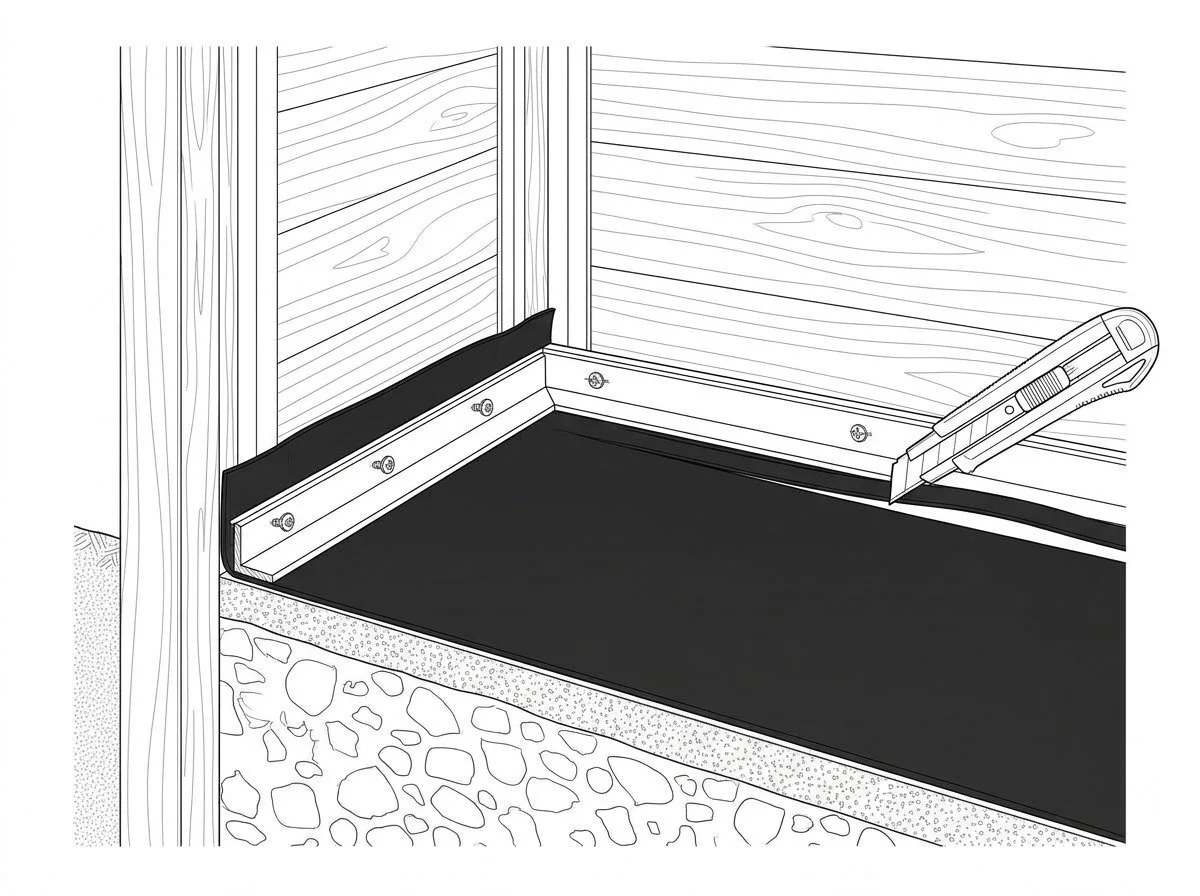
Step 3: Secure & Trim Edges (Wood vs. Masonry & Paddocks)
For Wood-Walled Stalls:
Press the upturned liner edge flat against the base of the wooden wall.
Place the fastening strip over the fabric at your desired height and secure it firmly using screws.
Use a sharp utility knife to trim away any excess liner cleanly along the top edge of the strip.
For Concrete Block Stalls, Wash Racks & Outdoor Paddocks:
Build a ground-level perimeter frame using pressure-treated 2×4s or 2×6s laid flat (wide side down).
In concrete block stalls, cut the boards slightly tight so they wedge snugly against the masonry walls, and lay a flush threshold board across the doorway.
Backfill the center with compacted base material until it sits level with the top of the wood frame.
Step 4: Add Bedding & Routine Maintenance
Bed Deep for Maximum Liner Life: Spread 6 to 8 inches of wood shavings or pellets over the liner. A deep cushion protects the fabric from pawing hooves while letting moisture wick downward away from the surface.
Easy Sanitizing & Odor Control: Whenever a deep refresh is needed, simply pour diluted barn-safe disinfectant (such as a pine-cleaner and water mix) directly through the liner to flush the sub-base, or apply granular stall deodorizers right over damp zones.
Where to use stall liners.

Versatile Drainage & Bedding Protection: Where to Use Stall Master Guard
While engineered primarily for equestrian facilities, our heavy-duty permeable stall liners provide superior moisture drainage, reduce ammonia buildup, and extend bedding life across a wide variety of livestock, agricultural, and pet housing applications. Explore the full list of animal enclosures and utility areas below:
- Horse Stalls & Foaling Stalls: Protects sub-bases from urine saturation, keeps wood shavings drier, and drastically cuts down mucking time.
- Equestrian Wash Racks: Provides high-traction, quick-draining footing that prevents standing water and mud accumulation during wash-downs.
- Paddocks & Run-In Sheds: Prevents hooves from churning high-traffic outdoor gateway zones into deep, dangerous mud during rainy seasons.
- Dog Kennels & Whelping Boxes: Offers a clean, sanitary, quick-draining surface under pine shavings, straw, or artificial turf for canine facilities.
- Alpaca & Llama Barns: Keeps fleece-bearing camelids clean, dry, and free from dusty or damp bedding conditions.
- Goat & Sheep Shelters: Manages heavy moisture and prevents strong ammonia odors from trapping in small-ruminant bedding.
- Mule & Donkey Housing: Built tough to withstand heavy pacing and digging while maintaining flawless sub-floor drainage.
- Cattle & Calf Maternity Pens: Keeps newborn calves and dairy/beef housing dry and comfortable.
- Pig & Swine Farrowing Houses: Manages high liquid output efficiently while supporting deep bedding or slotted flooring setups.
- Poultry Coops & Gamebird Runs: Goes underneath straw, hemp, or wood shavings in chicken coops to maintain dry litter and prevent damp, muddy bedding.
- Veterinary Quarantine & Recovery Stalls: Provides an easy-to-sanitize drainage layer for post-op animal care and treatment wards.
- Zoos & Exotic Animal Enclosures: Ideal for hoofstock, small mammals, and primate indoor shelters requiring heavy-duty waste management.
- Rabbit Hutches & Small Animal Barns: Controls heavy urine pooling and odor in multi-tier or colony housing setups.
- Equine Trailer Flooring: Enhances comfort and drainage underneath travel bedding during long-haul transport.
Frequently Asked Questions
Everything you need to know about Stall Master Guard installation, drainage, and care
Does it help with ammonia and odor?
Yes. Because liquid drains straight through the fabric instead of pooling on top of rubber mats or mixing into mud, urine is less likely to sit and break down into trapped ammonia odor.
Can it go over concrete or dirt?
Yes. It installs cleanly over bare dirt, clay, compacted stone dust, gravel, wood, or concrete—as long as the base is leveled and free of sharp rocks or debris.
Will horses paw through it?
Stall Master Guard is engineered from commercial-grade, high-tensile nonwoven polypropylene fabric built to resist tearing, stretching, and pulling under normal stall use when properly secured and covered with 6 to 8 inches of bedding. Maintaining full bedding depth protects the surface from direct hoof wear from persistent pawers.
How long does it last?
With normal daily mucking and proper bedding depth, a heavy-duty stall liner typically lasts 5 to 10+ years, even in active boarding and show barns.
How do I clean it?
Daily cleaning is faster than bare dirt because your pitchfork glides cleanly across the top without digging up rocks or mud. During periodic strip-outs, simply sweep it off, rinse with a hose, and wash down with your preferred barn cleaner.
How do I anchor or secure the liner in the stall?
Bedding weight alone will not hold the liner in place. You need to turn the edges up against the wooden stall walls and secure the perimeter using fastening strips and screws so the liner stays taut and prevents shavings from working underneath.
Should I run the liner slightly up the stall walls?
Yes—leaving 3 to 6 inches of extra fabric turned up along the bottom of the wooden stall walls creates a "tub" edge that you fasten down with strips and screws, keeping shavings and moisture sealed above the liner.
How do I measure my stall for the right liner size?
Measure wall-to-wall at the widest points of your stall and add 6 to 12 inches to both length and width so you have enough material to turn up the edges and anchor them to the wooden walls with fastening strips.
Can I cut or trim the liner to fit around posts or feeders?
Yes. You can easily trim the heavy-duty nonwoven fabric with heavy-duty shears or a sharp utility knife, and the needle-punched material will not unravel or fray.
What kind of bedding works best on top of a stall liner?
Kiln-dried pine shavings, pelleted wood bedding, chopped straw, and hemp bedding all work great when maintained at a 6 to 8 inch depth. Always keep the liner covered with bedding, as bedding absorbs moisture while the liner handles drainage and separation.
Can I put a stall liner underneath my existing rubber stall mats?
Yes. Laying a liner over dirt or stone dust before placing rubber mats helps prevent mats from sinking, shifting, or pumping mud up through the seams.
How do I prep a dirt or clay stall floor before installing?
Fill in any pawed-out holes, rake the floor level, and tamp it firm. Adding 2 to 3 inches of compacted stone dust or pea gravel underneath maximizes drainage in wet climates.
Will my horse slip on the liner?
Unlike smooth rubber surfaces that can get slick when wet, the textured nonwoven fabric is designed to offer reliable grip and traction underneath a full 6 to 8 inch layer of bedding. Keeping the liner properly covered with bedding ensures secure footing.
Can I use Stall Master Guard in outdoor paddocks, run-in sheds, and gateways?
Yes. Many horse owners install it in muddy gateways, around water troughs, and inside run-in sheds (topped with stone dust or sand) to help stop hooves from churning up deep mud.
How much money does a stall liner actually save on shavings?
Many barns cut shavings use by 50% to 60% (2 to 3x longer bedding life) because clean shavings don't get mixed into dirty base soil—often paying for the liner in roughly 3 to 4 months.